Monday, January 12, 2026
Home Blog Page 26

Payment Processor Square Purchases $170M Worth of Bitcoin, Ugandans Take Notice

0

On Tuesday last week, payment giant Square announced its purchase of 3,318 Bitcoin (valued at over 170,000,000 USD) within its open financial report. This represents nearly 5% of the company’s total assets, an incredibly ambitious move for a company of that scale. 

Within the financial report, the company stated that “the investment is part of Square’s ongoing commitment to bitcoin, and the company plans to assess its aggregate investment in Bitcoin relative to its other investments on an ongoing basis”. 

As of Tuesday morning, Bitcoin is valued at around $48,000, an increase of 62% since the beginning of 2021. Across the world, corporations and firms are eyeing Bitcoin as a valuable asset to increase their wealth. This purchase follows up the jaw-dropping $1.5 billion purchase of Bitcoin by Tesla earlier this month. Jack Dorsey, CEO of Square (as well as Twitter), is one of the most prominent advocates of Bitcoin and cryptocurrency. 

Ugandans are taking notice of the cryptocurrency revolution, and many are already buying and selling the asset on a daily basis. Jack Dorsey notably visited with a number of African cryptocurrency advocates, including CEO Chris Maurice of Yellow Card, an exchange that recently expanded to Uganda. 

His interest in cryptocurrency and its value to Africa has caught the attention of many avid investors, seeing it as a potential African technological revolution. When asked about Jack Dorsey’s visit, Chris Maurice said that “Jack has a keen eye, and I think many in the space take notice when he makes a move as big as his investments and support for cryptocurrency.” Yellow Card, which was founded in 2016, was inspired when its founders Chris Maurice and Justin Puiroux were shocked at the amount a traditional US bank was charging Africans to send money across borders. 

They teamed up with Munachi Ogueke to undertake the mission of bringing Bitcoin to Africa with the objective of “basic financial services for all” and have since taken Africa by storm operating in 13 countries and planning expansions to 5 more within the month. 

Yellow Card has strong educational ideals, hoping to educate the public on the utility of Bitcoin as a financial tool available to anyone as well as providing a safe and convenient means of buying and selling Bitcoin in Uganda. Yellow Card’s rapid growth has been its primary weapon in its battle to provide financial freedom for people across Africa. Whether it be for investing, sending money across borders, or simply for storing money, Bitcoin and cryptocurrency has a powerful and diverse range of applications. 

The recent price drop has provided an opening for those who felt that they had missed out on the Bitcoin revolution, and the number of people who own Bitcoin has been moving at an exponential rate. As Bitcoin’s value continues to rise and both tech and business gurus continue to sing its praises, the number of Ugandans using Bitcoin is expected to grow.

Spotify Now Available in Uganda, Releases Pricing Options

0

Two days ago, Spotify released a statement that it would be launching in several new 80+ markets including in Uganda, with a launch scheduled for the next few days after the announcement was made.

Today, the Company has finally become available in Uganda, releasing with it pricing options for its premium available products.

IndividualDuoFamilyStudent
1 free month with subscription1 month free1 month free1 free month with subscription
UGX 10,000/month after offer periodUGX 10,000/month after offer periodUGX 16,000/month after offer periodUGX 5,000/month after offer period
1 Account2 Accounts6 Accounts1 Account
Listen to music ad-free2 Premium accounts for a couple under one roof6 Premium accounts for family members living under one roofSpecial discount for eligible students in university
Play anywhere – even offlineDuo Mix: a playlist for two, regularly updated with music you both enjoyFamily Mix: a playlist for your family, regularly updated with music you all enjoyListen to music ad-free
On-demand playback
Ad-free music listening, play offline, on-demand playback
Block explicit musicPlay anywhere – even offline
Ad-free music listening, play offline, on-demand playbackOn-demand playback
Spotify offers

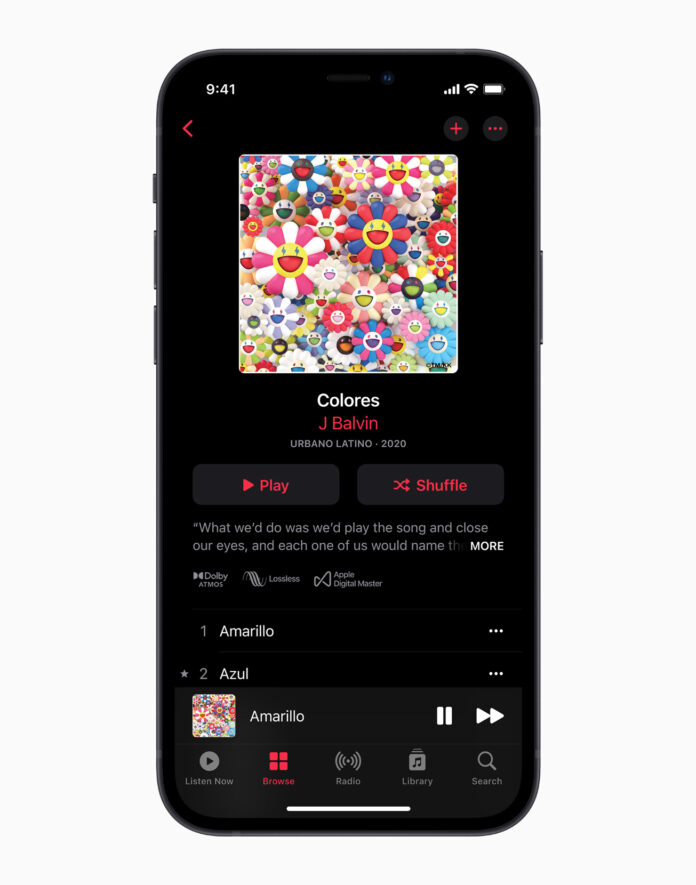
Several users in Uganda have taken to social media to express their excitement about the launch with some saying they would be quitting Apple Music.

Spotify has also provided two subdomains “spotify.com/ug-en” for English and “spotify.com/ug-sw” for Kiswahili speakers in Uganda, all dedicated to the Ugandan audience.

Spotify to Launch in Uganda, and 80 more new countries.

0

In a blog post on the company newsroom website, the “world’s most popular audio streaming subscription service”, Spotify announced that it will be expanding its “international footprint” and bring its sound to 80+ new markets in the next coming days, including in Uganda.

“As part of our ongoing commitment to building a truly borderless audio ecosystem … Spotify is embarking on a sweeping expansion that will introduce the world’s most popular audio streaming subscription service available to more than a billion people” reads the statement in part.

According to the statement, the 80+ countries being added to the count represent a billion people in the new markets, and with it will be 36 additional languages added to the platform in order to accommodate the new multilingual countries.

These new countries are from Asia, Africa, the Caribbean, Europe and Latin America. The full list includes;

Angola, Antigua and Barbuda, Armenia, Azerbaijan, Bahamas, Bangladesh, Barbados, Belize, Benin, Bhutan, Botswana, Brunei Darussalam, Burkina Faso, Burundi, Cabo Verde, Cambodia, Cameroon, Chad, Comoros, Côte d’Ivoire, Curaçao, Djibouti, Dominica, Equatorial Guinea, Eswatini, Fiji, Gabon, Gambia, Georgia, Ghana, Grenada, Guinea, Guinea-Bissau, Guyana, Haiti, Jamaica, Kenya, Kiribati, Kyrgyzstan, Lao People’s Democratic Republic, Lesotho, Liberia, Macau, Madagascar, Malawi, Maldives, Mali, Marshall Islands, Mauritania, Mauritius, Micronesia, Mongolia, Mozambique, Namibia, Nauru, Nepal, Niger, Nigeria, Pakistan, Palau, Papua New Guinea, Rwanda, Samoa, San Marino, Sao Tome and Principe, Senegal, Seychelles, Sierra Leone, Solomon Islands, Sri Lanka, St. Kitts and Nevis, St. Lucia, St. Vincent and the Grenadines, Suriname, Tanzania, Timor-Leste, Togo, Tonga, Trinidad and Tobago, Tuvalu, Uganda, Uzbekistan, Vanuatu, Zambia, and Zimbabwe.

Spotify will launch with free and premium plans allowing for family, duo and student plans offering a music catalog and podcasts to its new users. For the creators, the company promises to work with local creators and partners in order to expand their reach to global audiences with a “Spotify experience that meets the unique needs of each market”.

Previously and currently, any access to the platform in those countries has only been possible with VPN (Virtual Private Networks) that have widely been used in Uganda to access social media platforms that have continuously faced government shutdowns.

NMS Rallies Health Facilities to Follow Drugs’ Delivery Schedules

0

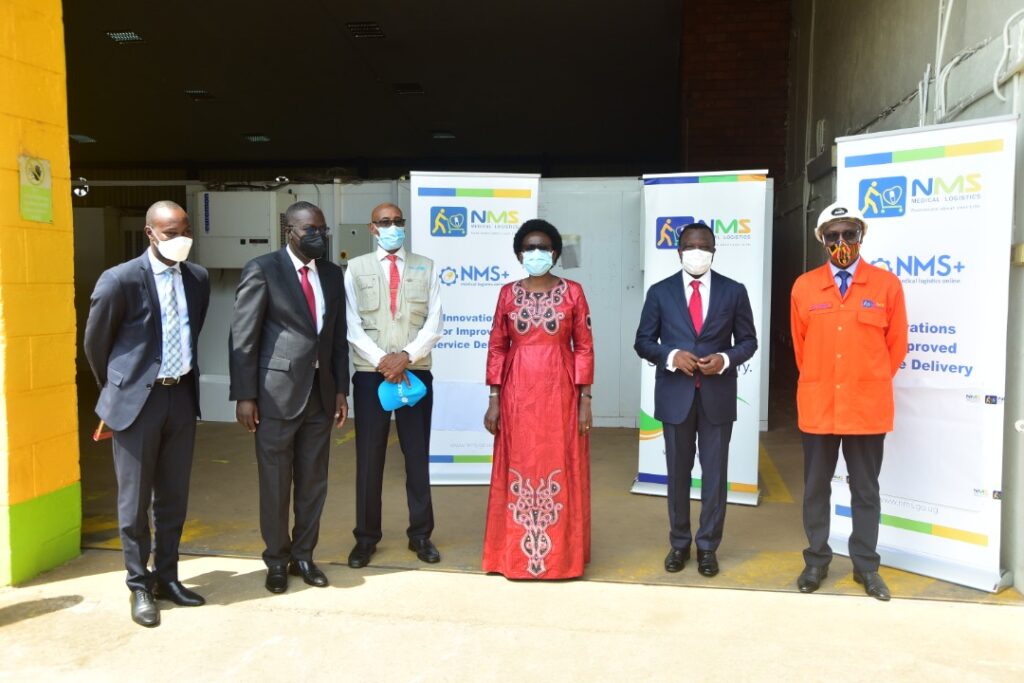
The National Medical Stores (NMS) has called upon all government health facilities to submit their medicine requests within the set deadlines according to the Store’s delivery schedule to enhance availability of medicines in the country.  

“Currently, we serve over 3,000 health facilities across the country and while a great number of them submit their requests on time, we still face challenges in some places where requests are submitted outside the set submission deadlines and this therefore affects availability of medicines in these particular places,” said NMS Public Relations Officer, James Odong.

“We therefore call upon all health facilities to help us help them by adhering to the delivery schedule guidelines available in the health facilities and the NMS website to enhance transparency and medicine availability,” he added.

Odong appreciated Government for the continued support in enabling the store execute its mandate and urged all Government health facility leaders to submit timely requests for deliveries to avoid inconveniences.

“The Government has been very supportive in ensuring we have a conducive environment for logistics and supply which enables us operate efficiently,” he said.

Odong further noted that the deliveries are made as part of the Store’s predetermined bi-monthly delivery schedule but considerations are made for emergency requests.

“NMS delivers drugs to various government health facilities across the country based on a pre-determined schedule every two months which translates into six times every year. Of course there are emergency deliveries but that does not happen regularly,” he emphasised.

“The purpose of these scheduled deliveries is to enable us manage the available resources efficiently and for accountability purposes especially now considering the COVID 19 pandemic and related effects on transport restrictions and availability of medicines globally,” Odong said.

The NMS delivered drugs, vaccines, soaps and fluids between 1st to 9th February 2021 to Omoro District, Otuke District, Lamwo District, Kitgum District, Oyam District, Lira District, Kwania District, Kole District, Dokolo District, Apac District, Alebtong District, Agago District, Kapelebyong District, Arua Regional Hospital,  Mulago National Burns Unit, Lira Hospital, Gulu Hospital, Kitagata Hospital, Katakwi District/Katakwi General Hospital, Moroto Hospital, Naguru Hospital, Mbarara University Hospital and Kabale Regional Hospital.

Other areas which received drugs during this aforementioned period are Soroti Regional Hospital, Mbale Regional Hospital, Jinja Regional Hospital, Ntlp, Kibuku District, Karenga District, Bukiwe District, Abim District/Abim Hospital, Mulago Hospital, Kayunga District, Bugweri District, Kotido District, Kampala National Burns Unit, Kaabong District/Hospital, Kamuli District, Moroto District, Napak District, Katakwi District/Katakwi General Hospital, Moroto Regional Hospital, Kayunga Hospital, Abim Hospital, Nakapiripit District, Nabilatuk District, Manafwa District.

NMS’ mandate is to procure, warehouse and distribute essential medicines and medical supplies, primarily to Government health facilities.

Medicine availability across the country currently stands at 85percent with a target of reaching 90 percent within the next 1-2 years.

NMS recently hired clerks to follow up on drugs from the districts up to the rural health facilities under what is known as the last mile delivery model. 

The institution is set to open a state-of-the art pharmaceuticals warehouse in Kajjansi off Entebbe road to increase bulk store capacity area from the current 8,000 pallet locations in the existing premises, to a minimum of 30,000 pallet locations.

The facility will also increase cold chain capacity to a maximum net storage volume of 2,500m3 purpose built as a Drive-in cold room (DICR). 

“One of our main objectives is to consolidate, centralize and operate NMS services and infrastructure in one modern, purpose built and efficient building, with a minimum sixty-year lifespan, on the specified site,” said NMS General Manager Moses Kamabare.

In the year 2017/2018, NMS achieved higher than target score of 90 percent stock availability for Essential Medicines and 86percent for Tracer items against a target of 75 percent set by Ministry of Health. 

This media house understands that in the financial year 2018/19, NMS attained 92 percent stock availability for 41 Tracer Medicines at Central level against a target of 80 percent from Ministry of Health. Hi

NITA (U) Finds Safe Boda in Breach of Data Protection Law, Let off with Impunity

0

In 2020, a watchdog, the Unwanted Witness released a report wherein it made allegations that Safe Boda, a ride hailing app, was conducting practices that breached Uganda’s data protection laws, principally, the “Data Protection and Privacy Act 2019 (DPPA)”.


Following the release of the report, a concerned citizen Obedgiu Sammy appealed to the speaker of Parliament, Rebecca Kagada, petitioning that the Company should be investigated and penalised for sharing user’s personal data without their consent. The speaker then directed Uganda’s National Information Technology Authority (NITA) Uganda to conduct the said investigation and report back to it in due time for action.


A report from that investigation was released at the end of January last month and the findings have been made available online. While the Authority did not find evidence to fault the company for selling any user data, it found that Safe Boda specifically breached section 35 of the DPPA when it;


“…unlawfully obtain(ed), disclose(d) or procure(d) the disclosure to another person of personal data held and processed by a data collector, data controller or data processor”.


The basis for the above guilt was premised on the findings that the consents that the Company claimed to have acquired when the users registered for the Safe Boda application, were not sufficient enough to enable the end user make an informed consent as “the ‘consents’ relied upon for the disclosure were not specific because they did not disclose the parties with whom the information was going to be shared with”.


One of the third parties that the information was shared with was CleverTap to which the company claims it shared data with for “behavioural analysis” purposes.


“NITA’s finding is that Safe Boda’s disclosure of its users’ personal data to CleverTap contravened the Data Protection and Privacy Act”, reads part of the findings. The report however goes on to note that there was no evidence to support allegations that the company sells its users’ personal data.


While the Company was found to be in breach, NITA (U) did not recommend any prosecution or penal action to be taken against the spirit of the DPPA, that would have found the company liable and penalised it.


Under the above section, it is stated that any person that breaches the above provision “commits an offence” and when convicted, a fine not exceeding two hundred and forty currency points shall be payable or imprisonment for 10 years or both, the fine and imprisonment.
The breach has been found, but the company has been let off.

Following recommendations in the report, Safe Boda has released an updated set of terms and conditions that have since gone viral on social media, as the company excludes itself from any form of liability arising from the use of its platform. It has also highlighted the names of third parties with whom user personal data is shared.

The actions to be taken by Parliament are yet to be ascertained given that the speaker requested that the findings be furnished to her.

MTN Uganda begins offering Home Fiber Services

0
Photo by Ildefonso Polo on Unsplash

MTN Uganda has been offering fiber services for her Business clients but, this website was able to determine that MTN is indeed rolling out the internet fiber service to her Home clients in Uganda.

Tucked away at the bottom of the MyMTN app, under the section of ‘Buy’ users are now able to request for MTN Home Fiber services.

We have determined that Home Fiber services will have an installation fee of UGX 100,000/- and the telecom will offer a standard 10Mbps or Premium 40Mbps package at UGX 179,000/- and UGX 279,000/- per month respectively. All payments will be paid via mobile money.

MTN Uganda Home Fiber Prices

PackageSpeedPrice (UGX)
Standard10Mbps179,000/-
Premium40Mbps279,000/-
Installation FeeN/A100,000/-

MTN says that it will deliver optic fiber directly to your home and will provide a reliable high-speed internet connection with no cap on data volume to enable users to meet their entertainment, education, surveillance and home office needs.

As of writing MTN Home Fiber will be available in parts of the following areas; Kololo, Nakasero Hill, Makerere, Bugolobi, Luzira, Ggaba, Makindye, Muyenga, Namuwongo, Nsambya, Ntinda Bukoto, Ntinda (Kyambogo – Minister’s Village), Ntinda (Kiwatule – Naalya), Kira, Kisaasi, Bweyogerere, Najjankumbi, Entebbe, Mukono, Jinja, Mbale, Arua and Lira.

The application has more detailed locations within the above-selected areas to ensure that users are in the right Fiber zones before requesting for the service. It is unfortunate that the Terms and conditions for usage indicated in the mobile app have nothing to do with the service but rather relate with MyMTN and not the Home Fiber solution.

For now we were unable to gain access to the Fair Usage Policy of MTN’s Home Fiber. Since the service is labelled as ‘Up to 10Mbps’ or ‘Up to 40Mbps’, we still unable to determine where it is a shared 10Mbps link or a dedicated link with both 10 up and down speeds.

We shall be sharing this information and a detailed connection review after in-depth testing of the service.

We are glad that more companies are rolling out fiber connections to their customers as this usually ensure a stable connection. You can let us know whether you are excited about the roll-out of MTN Home Fiber in the comments below.

Bill and Melinda Gates Release 2021 Annual Letter dubbed “The Year Global Health Went Local”

0

Bill and Melinda Gates share their 2021 Annual Letter, “The Year Global Health Went Local.” In this year’s letter, Bill and Melinda reflect on the worldwide impact of COVID-19 and the global collaboration and scientific innovation fueling one of the largest public health efforts in history. They share why they are optimistic the world can emerge from the pandemic stronger, healthier, and more resilient, and discuss two areas they believe are essential to building a better future: prioritizing equity and preparing for the next pandemic.

“COVID-19 has cost lives, sickened millions, and thrust the global economy into a devastating recession,” Bill and Melinda write. “Although we have a long recovery in front of us, the world has achieved some significant victories against the virus in the form of new tests, treatments, and vaccines. We believe these new tools will soon begin bending the curve in a big way.”

Bill and Melinda argue that in response to the pandemic, donors from around the world contributed resources, competitors shared research findings, and years of global investment helped unlock a new era in vaccine development, delivering safe, effective vaccines in record time. They caution, however, that the pandemic has also exacerbated pre-existing health disparities, particularly for essential workers, communities of color, people experiencing poverty, and women. They express concern that the pandemic could also perpetuate another type of injustice: immunity inequality. They call for an inclusive response that addresses the uneven social and economic impacts of the virus.

“From the beginning of the pandemic, we have urged wealthy nations to remember that COVID-19 anywhere is a threat everywhere. Until vaccines reach everyone, new clusters of disease will keep popping up. The cycle of inequality will continue,” Melinda writes. “Everything depends on whether the world comes together to ensure that the lifesaving science developed in 2020 saves as many lives as possible in 2021.”

Bill and Melinda also stress that it’s not too early to think about the next pandemic. Although stopping it will require tens of billions of dollars per year, they note that COVID-19 has cost the world an estimated $28 trillion. They urge continued investment in testing, treatments, and vaccines, and discuss the importance of a global alert system that can detect disease outbreaks as soon as they occur.

“The world now understands how seriously we should take pandemics,” Bill writes. “We’re already seeing new pandemic preparedness strategies emerge and I expect to see more in the months and years to come. The world wasn’t ready for the COVID-19 pandemic. I think next time will be different.”

The Bill & Melinda Gates Foundation was established with the belief that every person deserves a chance to live a heathy and productive life. To-date, the foundation has committed $1.75 billion in the fight against COVID-19, including support for partners in the development and equitable delivery of vaccines, tests, and treatments.

To read the letter in its entirety, visit www.gatesletter.com.

Report: Blockchain hackers stole $3.8 billion in 122 attacks in 2020

0
Photo by Launchpresso on Unsplash

Atlas VPN has released a report on how much cryptocurrency was stolen by hackers in the year 2020. Below is the report in its full depth

The year 2020 was challenging for cybersecurity and the world in general. The global pandemic did not only threaten our physical health but also gave way to a new wave of cyberattacks endangering our digital lives.

It seems that the worldwide chaos hardly affected the blockchain world as cryptocurrencies, such as Bitcoin, saw a significant rise in their value by the end of 2020. Nevertheless, the blockchain sector did not evade cyberattacks last year.

Atlas VPN team found that blockchain hackers stole nearly $3.78 billion in 122 attacks throughout 2020. Blockchain-linked attacks that happened last year alone account for almost a third (33%) of all time hacks aimed at blockchain projects.

The numbers are based on the data provided by Slowmist Hacked, which aggregates information about disclosed attacks aimed at blockchain projects, apps, and tokens. The data also considers blockchain scams, which make up 13% of all blockchain hack events in 2020. Monetary losses were calculated based on the January 12th, 2021 conversation rate.

Ethereum (ETH) DApps, decentralized applications based on the Ethereum smart contract, were the most frequently breached blockchain target. In 2020 alone, there were 47 successful attacks aimed at ETH DApps, which cost victims around $436.36 million or $9.28 million per hack.

Cryptocurrency exchanges, businesses that allow their clients to trade crypto to other assets, were also highly targeted last year. In 2020, there were 28 cryptocurrency exchange breaches, which together amounted to $300.15 million in losses or approximately $10.72 million per hack.

The third spot in the list is occupied by blockchain wallets — digital wallets that allow crypto holders to store their cryptocurrencies. Last year, hackers launched 27 successful attacks aimed at crypto wallets, netting $3.03 billion or around $112.12 million per hack. The nature of blockchain wallets makes them the most profitable target to cybercriminals.

Blockchains themselves were also affected by hacks in 2020. The year saw 12 successful attacks launched at different blockchains, which brought cybercriminals $5.91 million or $492,517 per each breach.

Next up are Tron DApps and EOS DApps. Like ETH DApps, they are decentralized applications based on specific protocols. Each type of DApps was breached three times last year. In total, Tron DApp breaches cost victims $10 million or around $3.33 million per hack, while EOS DApps caused damages of $2.85 million or approximately $949,416 for each breach.

Finally, 2020 saw two scams involving Ethereum-based tokens, a type of the token issued solely on the Ethereum blockchain. However, it is not clear how much financial damage these scams have caused.

Blockchain-linked hacks drop for the first time in 5 years

In our mid-year report on blockchain-related attacks, we observed a decline in hacks. Now that 2020 finally wrapped up, we can see that the trend persisted till the end of the year. In 2020, blockchain-related hacks dropped for the first time in the last five years.

The year 2019 saw 133 coordinated attacks targeting various blockchain platforms, apps, and tokens, while in 2020, the number decreased by 8% to 122. While the drop is not very significant, it still indicates an overall decline in blockchain-related hacks.

Let’s look at the attack numbers quarter by quarter. In contrast to 2019, when most blockchain-related breaches took place in the first quarter of the year, the first three months of 2020 saw the least amount of successful attacks. In 2020 Q1, 13 blockchain-related hacks were detected.

In the second quarter of last year, blockchain-linked breaches rose by 54% to 20. Q3 of 2020 saw an increase in attacks again by 160% to 52 attacks — the most out of all the quarters last year. Finally, the number of detected breaches fell by 29% to 37 in the last quarter of 2020.

It is hard to say what the future holds for the blockchain in terms of security. We are only in the middle of January, and two successful attacks, as well as one blackmail case involving cryptocurrency, have already been reported.

Nevertheless, the numbers are not near the ones recorded in the record-breaking year of 2019, when 31 attack took place in January alone. Therefore, the breaches may continue to decline in 2021.

Followers Gallery: An incredible application that has assisted me with getting Instagram followers and likes for free!

0

Getting followers on Instagram is slowly becoming an issue. I don’t mean to scare you with this claim, even though the methods used to try to get followers with the last difference in the Instagram account (March 2019) do not work. The desire to advance “ human” use and the camaraderie between clients using this stage is real, with Instagram making significant improvements that are affecting many records. Along with Facebook, Instagram is a star- studded organization that exists beyond everything else, and for some it has become an amazing individual brand and business tool. So we are discussing important changes. This development not only affects profiles. This is how they affect their publications (mainly affecting the natural accessibility of their publication)  .However, don’t stress: you are in acceptable hands. Instagram is one of the few informal organizations I’ve worked with recently, and it has allowed me to get information with which I have gained about 1000 new followers on Instagram. Has set a record.

Instagram is a very popular social media application. Today, almost all companies have their own Instagram accounts. They use Instagram because this application is very effective in digital marketing. However, this effect really depends on the number of followers and likes and account receives. If an account has very few followers and likes, it means that there is very little interaction on the account and obviously this is not a good situation.

It’s that we’re discussing ”VIP” insights, yet we’re discussing the amount of real followers that any online entrepreneur like me will find the best results in general. I progressed because I was offered an incredible application called Followers Gallery With this application, it’s easy to get free Instagram likes and followers. Also, obviously it’s safe ! I’ll explain in the accompanying sections !

What is the Followers Gallery? How can this give me free Instagram followers and likes?

Followers Gallery is an incredible application that every Instagram client needs multiple followers and naturally likes. This is a free Instagram followers mod apk. Why would it be good idea to use your Followers Gallery?

-You do not have to pay a penny with this application. Ignore the millions of dollars spent on fake followers and favorites.

-100% infection free. Your gadget will be safe once this application is introduced.

-Supports 24 hours every day and 7 days a week. Whenever you have trouble, the Followers Gallery group is always ready to help

-Every supporter you meet is genuine in light of the fact that they are made up of real Instagram clients.

-Easy to cooperate. You do not need an online media master to run this application efficiently

-This Instagram Auto like Application strengthens both Android and iOS. Although your telephone uses one of two working frameworks, you can download the application and find similar free Instagram followers and strategies of your choice

-There is no limit to the coin. The amount of coins you control is controlled by the amount you follow and the Instagram followers through the records of different followers in different galleries.

So the question is, who are you bored with? Don’t you need to get unlimited free Instagram followers and likes?

How Artificial Intelligence Helping African Farmers in the Fight Against Locusts

0

Kuzi, a free tool that will help farmers and pastoralists across Africa to predict and control locust behaviour has been launched. Kuzi uses satellite data, soil sensor data, ground meteorological observation, and machine learning to predict the breeding, occurrence, and migration routes of desert locusts.  

Kuzi—the Swahili name for the wattled starling, a bird renowned for eating locusts—is an AI-powered tool that generates a real-time heatmap of locusts across Africa, shows all potential migration routes, and gives a real-time locust breeding index.

Using satellite data, soil sensor data, ground meteorological observation, and machine learning, Kuzi can predict the breeding, occurrence and migration routes of desert locusts across the horn of African and Eastern African countries, and uses deep learning to identify the formation of locust swarms. Kuzi then sends farmers and pastoralists free SMS alerts 2-3 months in advance of when locusts are highly likely to attack farms and livestock in their areas.

Without preventative measures, a swarm of 80 million locusts can consume food equivalent to that eaten by 35,000 people a day, devastating food stocks for vulnerable communities. Putting in place early detection and control measures, which are critical in desert locust management, will offer farmers and pastoralists a vital tool in the fight against world hunger and food insecurity.

Alerts are currently available for Ethiopia, Somalia, Kenya, and Uganda, in the regional languages of Kiswahili, Somali and Amharic, spoken by over 200 million people across Eastern Africa.

“The first international anti-locust conference was held in Rome in 1931 and yet Africa continues to experience locust invasions almost 100 years later, with the worst locust invasion in 70 years occurring in 2020, threatening food supplies for millions of people across Eastern Africa. There has to be a better way to do this, one that has the local communities being central in the fight against locusts,” said John Oroko, CEO of Kuzi’s creator, Selina Wamucii.

“A new wave of locust upsurge now threatens millions across Eastern and Southern Africa, exacerbating food insecurity for already vulnerable communities, amidst the challenges of the COVID-19 pandemic. We have a responsibility to develop and deploy locally bred solutions that address these challenges faced by our vulnerable rural communities,” adds Oroko.

The free tool is currently available to users in Somali, Ethiopia, Kenya, and Uganda with plans to roll out to cover the rest of Africa.

Farmers can sign up for the free SMS alerts with any mobile device, with or without an internet connection, capture the GPS location of their farm, and they are good to go, without any charges.

*Editors Note: This is a press release from

LATEST POSTS

Follow GURU8

3,734FansLike
15FollowersFollow
1,046FollowersFollow
19SubscribersSubscribe