
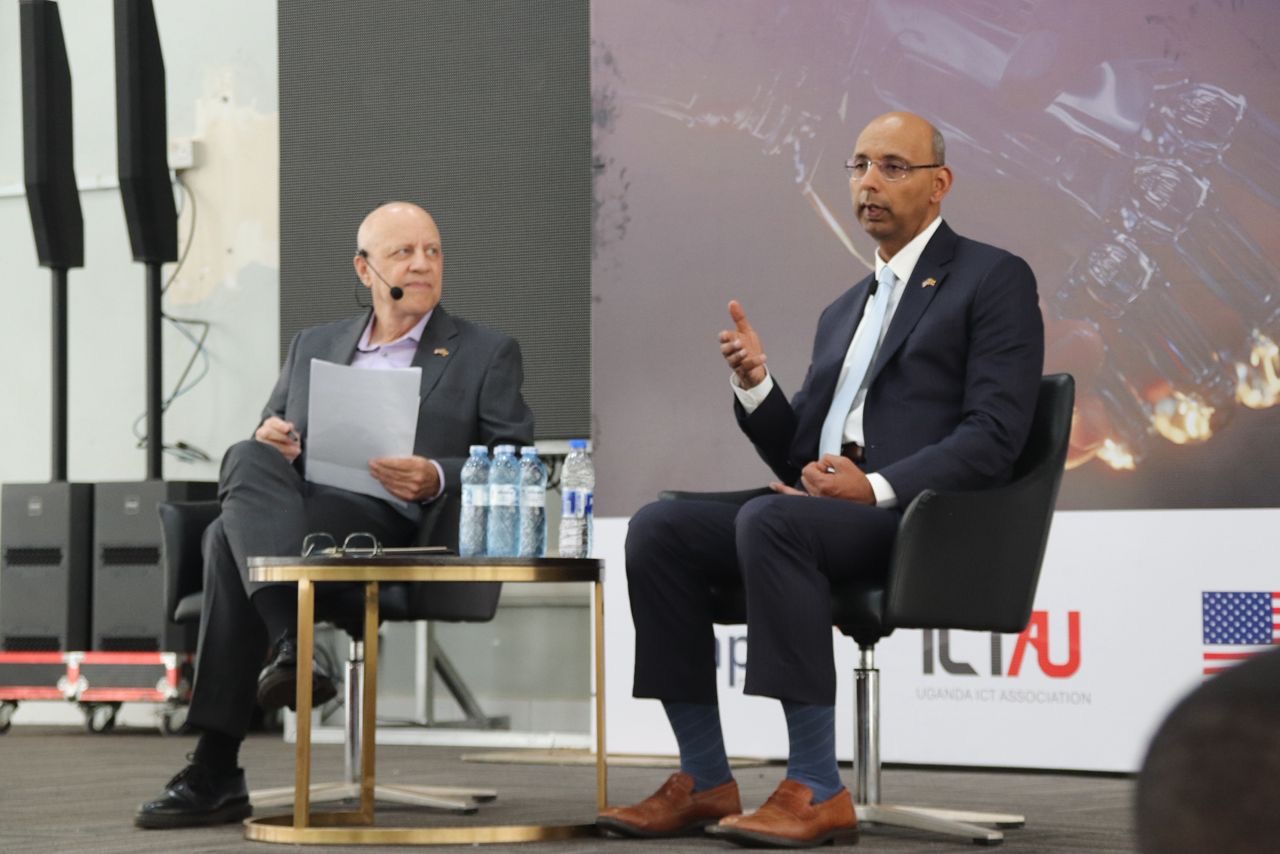
Simplifi Networks, in partnership with the U.S. Embassy Uganda and the Uganda ICT Association (ICTAU), today hosted a landmark half-day forum on artificial intelligence for Ugandan entrepreneurs and business leaders.
The event, titled State of AI for Entrepreneurs and Ugandan Businesses, brought together participants from across the country at the National ICT Innovation Hub in Nakawa for a morning of expert-led discussion, practical insight, and forward-looking dialogue on the opportunities AI presents for Uganda’s economy.
The forum opened with an address by the U.S. Ambassador to Uganda, H.E. William W. Popp, followed by an in-depth presentation from internationally recognised AI and technology expert Vivek Mohindra, and a lively Q&A session moderated by Ken Stober, CEO of Simplifi Networks. The room reflected the breadth of AI’s relevance across Uganda’s economy, with entrepreneurs, business owners, technology professionals, and policymakers all in attendance.
A Present-Day Opportunity, Not a Future Possibility
Ambassador Popp set the tone for the morning with a clear message: the AI era is already here.
“AI is here, it is now, and it is already transforming economies around the world, including here in Uganda,” he said, noting that the United States has made AI leadership a national priority through sustained investments in innovation, infrastructure, and global partnerships.
The Ambassador also underscored the significance of the Uganda–U.S. partnership, framing it as a vehicle for unlocking real economic opportunity through trade, investment, and knowledge exchange.
ICT as the Engine of Uganda’s Growth Agenda
Grace Achire Labong, Director and Head of Stakeholders Engagement at the ICT Association of Uganda, reinforced the centrality of technology to Uganda’s development ambitions. She described ICT not as a standalone sector, but as a foundational enabler cutting across the country’s priority growth areas; Agriculture, Tourism, Minerals, and Services.
“ICT is not just a sector, it is an enabler that cuts across all others,” she said. “If we are to achieve our goal of tenfold economic growth, technology must be at the center of that transformation,” she added.
Achire also revealed that Uganda is already taking concrete steps toward structured AI adoption, with national frameworks and policy guidelines under development to guide the responsible and impactful deployment of emerging technologies.
The Global AI Landscape: Collaboration Over Competition
Drawing on a distinguished career spanning Dell Technologies, McKinsey & Company, Freescale Semiconductor, TPG Capital, and New Science Ventures, Vivek Mohindra challenged the audience to reframe how they think about AI, not as a single monolithic technology, but as a diverse ecosystem of tools suited to different challenges and contexts.
“There is no one AI system that is superior in all scenarios. The real question is: which AI works best for the problem you are trying to solve?” he said.
On the question of global competition, particularly from China, Mohindra urged stakeholders to shift focus from rivalry to readiness, specifically, preparing for the rise of agentic AI: systems capable of autonomous perception, decision-making, and action, which he described as the next major wave of technological transformation.
Data Governance and Responsible AI
A recurring theme throughout the discussions was the critical importance of data governance. As AI systems depend fundamentally on data, experts called on governments and organisations to be deliberate and rigorous about how data is collected, stored, and used.
“AI is fundamentally about data. We must be careful about where that data goes and how it is used,” Mohindra noted.
Speakers also called for balanced regulatory frameworks, ones designed to stimulate innovation while protecting consumers and upholding ethical standards.
Three Pillars for Unlocking AI’s Potential
Across the discussions, speakers converged on three areas requiring coordinated national action to fully realise AI’s transformative potential: infrastructure investment, including data centres and energy systems; workforce development to build an AI-ready talent base; and agile regulatory frameworks capable of keeping pace with rapid technological change. The United States, through institutions such as the International Development Finance Corporation and the Export-Import Bank, is already mobilising financial tools to support global technology partnerships in these areas.
Entrepreneurs and Youth at the Heart of Uganda’s Digital Future
The forum placed particular emphasis on the agency of Uganda’s entrepreneurs, ICT professionals, and young people in shaping the country’s AI trajectory.
“You are the ones who will build the applications, create companies, and generate jobs,” Ambassador Popp said, calling on Uganda’s next generation of innovators to step into an active role in building the country’s AI ecosystem.
Looking Ahead
The ICT Association of Uganda announced plans for its upcoming National ICT Summit in September, which will focus on leveraging technology to accelerate growth across priority sectors, deepening the national conversation on AI, policy, and digital transformation.
As the forum drew to a close, a clear consensus had emerged among speakers and participants alike: AI represents a generational opportunity for Uganda, but one that demands collaboration, strategic investment, and responsible governance to deliver inclusive and lasting impact. With strengthened Uganda–U.S. partnerships and growing local momentum, stakeholders left the morning session with a shared sense of optimism about the road ahead.